Showing posts with label Paul Leni. Show all posts

Monday, 11 July 2011

The Last Warning (1929)

Directed by: Paul Leni
Starring: Laura LaPlante
              Montagu Love
              Roy D'Arcy
              John Boyles
Run time: 88 mins
Studio:    Universal
Black & White

The Last Warning was Universal Studio’s unsubtle but entirely understandable attempt to cash in on the huge success of 1927’s The Cat and the Canary. Unfortunately, however, as a follow-up to the earlier film, The Last Warning can only really be regarded as a qualified success. Indeed, if truth be told, it’s something of a disappointment. This is doubly sad when you consider that it was director Paul Leni’s last film (tragically, he died of blood poisoning not long after it was made). I should make it clear from the outset, however, that the disappointment doesn't stem from any lack of ability on Leni's part - he remained to the end one of early Hollywood's most inventive directors. No, the problem lies entirely with the script (and yes, you guessed it - it's another stage play adaptation!).

The film opens with a dizzying montage sequence depicting 1920s Broadway - the so-called “electric highway of happiness” - with its bright lights, limousines, dancing girls and blackface minstrels. We arrive at the Woodford Theatre (in reality the re-used Paris Opera House set from Phantom of the Opera) on the opening night of a play called The Snare; but there is panic in the stalls -  John Woodford (D'Arcy Corrigan), leading light of the Broadway stage, has been murdered during a mysterious blackout in the play's first scene (the obvious joke about actors dying on stage is mercifully resisted) and his fellow actors are in the process of being questioned backstage by the police. The theatre's owners, Josiah and Robert Bunce (Burr McIntosh and Mack Swain), brothers who speak in unison, are also in attendance. During the questioning, Irish stage manager Mike Brady (Bert Roach) reveals how he overheard a terrible argument between the play's director, Richard Quayle (John Boles) and Woodford coming from the leading lady's dressing room the night before. It turns out that the leading lady, Miss Doris Terry (Laura La Plante) is a very popular young lady indeed - not only is her dressing room filled with ostentatious floral bouquets from John Woodford (who apparently considered Terry the love of his life), but there are roses from Richard Quayle, too. In addition, there is a framed photograph of caddish-looking fellow actor Harvey Carleton (Reg D'Arcy) inscribed with Carleton's own message of adoration.  The film is barely fifteen minutes old and already the suspects are lining up. Things become even more suspicious when the Coroner (Harry Northrup) arrives and discovers that while everyone has been talking, Woodford's body has mysteriously disappeared. So far, so good - it looks as if we might have a decent mystery on our hands.


Thursday, 19 May 2011

The Cat and the Canary (1927)

Directed by Paul Leni
Starring: Laura La Plante
              Creighton Hale
Run time: 82 mins
Studio: Universal
Black & White

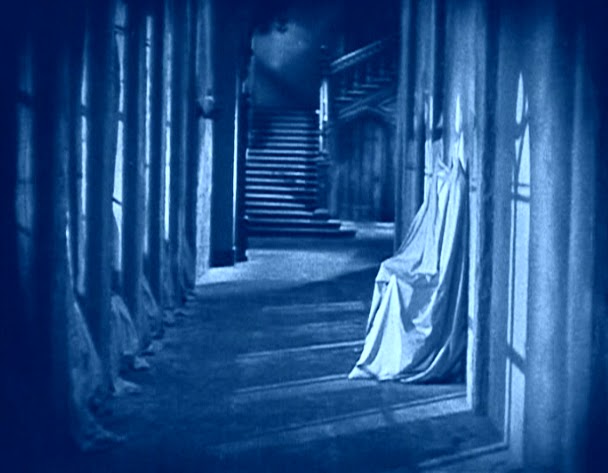
Based on John Willard’s popular Broadway stage play, Paul Leni's The Cat and the Canary holds the distinction of being the first 'proper' horror film produced by Universal Studios following the success of 1925's The Phantom of the Opera. As such, it marks the beginning of a cycle of films that would go on to have a profound influence on the genre; and for all that it is a very early entry in the ‘old dark house’ sub-genre, it’s probably fair to say that The Cat and the Canary remains the definitive example of the form, responsible for countless imitations and the subject of no less than five remakes. Noting the success of previous film adaptations of similar Broadway material (such as The Monster (1925)) Universal Studios were perhaps playing it safe by opting to film John Willard’s play; but the result is a film that bids fair to be called the first classic American horror movie.
Leni was a German Expressionist filmmaker whose previous works had included the fantasy anthology Waxworks (1924), and it was this film that brought him to the attention of Universal founder, Carl Laemmle. What set Leni apart from his Expressionist contemporaries, however, was his willingness to adapt the non-realist tropes of Expressionism (such as geometrically absurd sets) to satisfy the needs of a more mainstream audience, without sacrificing the movement's use of shadow, lighting and scenery to influence mood. He also seemed possessed of a playful sense of humour, which was undoubtedly another reason why Laemmle felt that he was the right man for the job - The Cat and the Canary is another horror comedy, after all. There’s no denying that the film's plot is simplistic (and was probably verging on the hackneyed even in 1927) but Leni set out to transcend the story's limitations by concentrating instead on the film's mise en scène. The result is a veritable triumph of style over substance, hugely entertaining, and one of the most forward-looking horror films of its day.
From the start, Leni takes every opportunity to do something different with the material: the opening credits, for example, are standard title cards, but are revealed by a hand brushing away cobwebs. The film's prologue isn't simply narrated on intertitles, but is told in a series of extraordinary dissolve shots. We meet Cyrus West, a dying millionaire, trapped in his fortress-like mansion, besieged and driven to the verge of madness by his greedy relatives. The spiky towers of his grotesque house are seen transforming into towering medicine bottles, symbolising West's terminal condition, which then transform into a clowder of giant hissing cats representing the relatives who are tormenting him and goading him towards death. We learn that West's last will and testament isn't to be read until twenty years after his death. It is sealed in an envelope and locked away in a hidden safe; but whose hairy, spider-like hand is this we see removing it from the safe? And what of the second envelope, never to be opened if the terms of the will are carried out?